Efficient compressed air supply
21. February 2024
The key is in the choice of compressor!
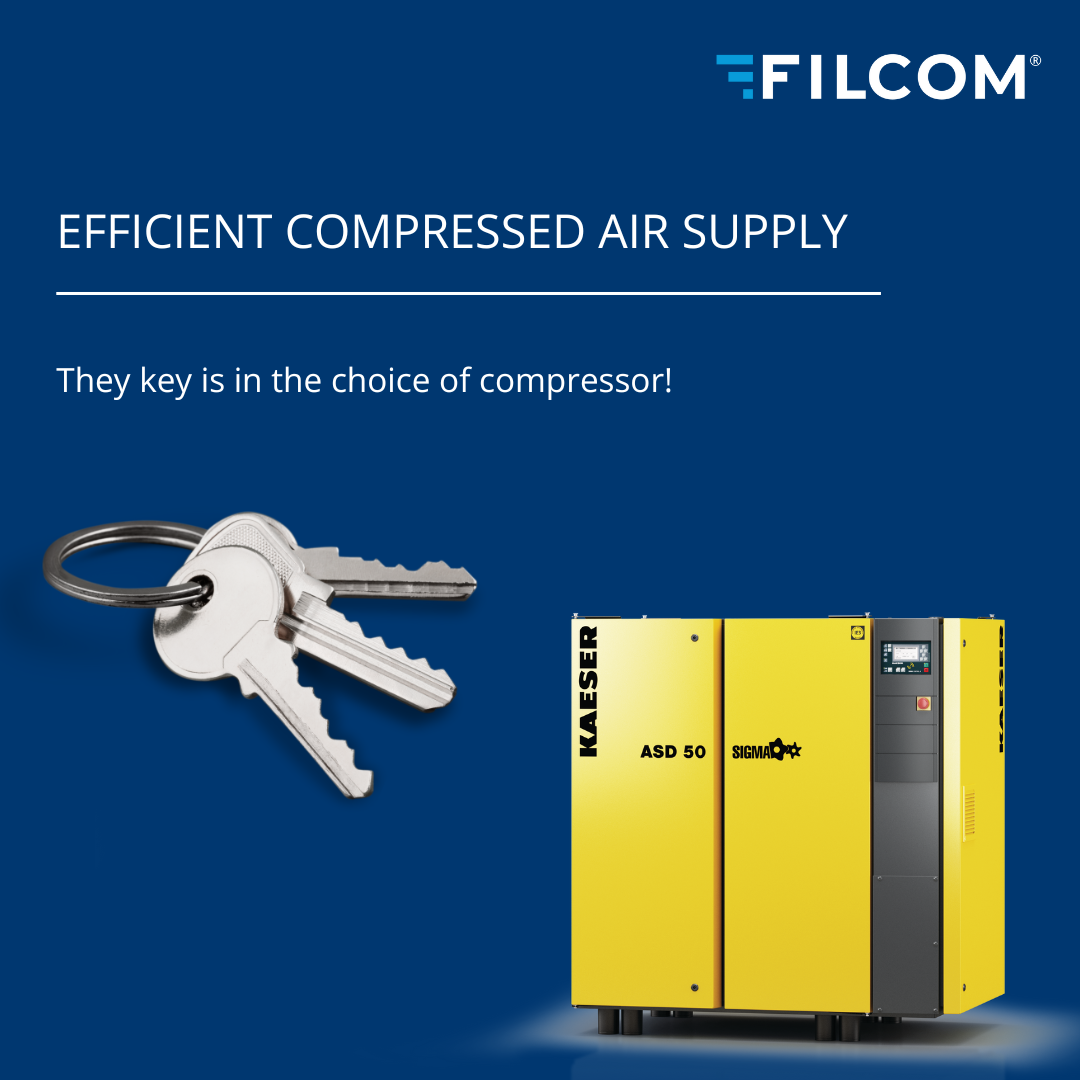
Efficient planning of a compressed air station begins with careful selection of the appropriate compressor. Regardless of whether it is a workshop or an industrial application, the compressor must primarily meet the requirements of compressed air consumers in terms of volume flow and compressed air quality. In addition to reliability, the cost-effectiveness of the compressed air supply also plays a crucial role. Through targeted optimization, significant energy savings can be achieved and costs can be reduced.
It is important to keep life cycle costs in mind. The total cost of producing compressed air is made up of three main factors: the investment costs, the ongoing maintenance and repair costs and the energy costs for operating the compressor. Contrary to popular expectations, acquisition and service costs only make up a small portion of life cycle costs. The majority of the total expenses are energy costs. Therefore, an investment in an efficient compressed air supply can pay for itself in a short time, depending on the operating hours, the degree of utilization and the current energy prices.
THE KEY COMPONENTS FOR INCREASE EFFICIENCY
- Compressor block: The core of an efficient compressor lies in the compressor block. Large compressor blocks that are operated at low speeds in their energetically advantageous range deliver more compressed air compared to small, high-speed blocks with the same drive power. Low speeds also mean less wear and therefore lower maintenance costs. Under the motto: “More compressed air with less energy,” KAESER screw compressors rely on the energy-saving SIGMA PROFILE. This flow-optimized technology enables energy savings of up to 15 percent compared to conventional profiles.
- Drive: The proven 1:1 direct drive has proven to be optimal for maximum efficiency of the compressor block. This connects the compressor block directly to the drive motor without any transmission losses. KAESER screw compressors also rely on this loss-free drive. In addition to the benefits of lower energy costs, the direct connection of engine and block also enables lower maintenance costs and minimal noise emissions. This means that additional expenses for noise insulation are a thing of the past.
- Motor: Energy-efficient motors play a crucial role in ensuring efficient operation of the compressor. Super premium efficiency drive motors according to IE4 impress with their extraordinarily high efficiency. This efficiency is particularly evident when the compressor is operated at full load for a significant number of operating hours. In addition, these highly efficient motors are better able to handle short-term overloads due to their sophisticated temperature management. This means they can be optimally adapted to specific applications. The motors are extremely robust and almost maintenance-free. With KAESER compressors, super premium efficiency drive motors according to IE4 are standard equipment. These help to significantly increase the cost-effectiveness and energy efficiency of the system.
IN HARMONY WITH INCREASED EFFICIENCY
The usual profile of compressed air consumption is in the range of 30 to 70 percent of maximum consumption. In this area, a speed-controlled screw compressor with a synchronous reluctance motor can optimally develop its advantages in terms of energy savings. This motor series combines the advantages of asynchronous and synchronous motors in one drive. Especially in partial load operation, it has a significantly higher efficiency compared to similar asynchronous motors, which enables savings of up to 10 percent.
In addition, the low moment of inertia of synchronous and reluctance motors ensures very short cycle times, which increases the productivity of the systems. Since neither aluminum, copper nor expensive rare earths are used in the rotor of these motors, the drive proves to be particularly robust and easy to service – at the same time protecting the environment and resources.
KAESER screw compressors already benefit from the impressive efficiency of these motors, making them true experts in energy savings.
SPEED CONTROL: AT THE TIME OF EFFICIENCY, THE FREQUENCY TO SAVE ENERGY!
A compressor’s speed control plays a crucial role in saving energy, especially when compressed air demand fluctuates. By adjusting the engine speed to the current load, the rotor speed can be reduced when demand falls, which leads to minimizing energy consumption.
In compressed air systems with fixed speed components, even the use of a single speed-controlled compressor can result in significant energy savings. This reduces the running times and load changes of the other systems, thereby maximizing the overall efficiency of the station.
The KAESER screw compressors can also be equipped with a speed-controlled drive, the SIGMA FREQUENCY CONTROL (SFC). In conjunction with a synchronous reluctance motor, KAESER achieves the best system efficiency IES2 according to EN50598.
COOLING & THERMAL MANAGEMENT – TINY DETAILS WITH A HUGE EFFECT
There is often significant savings potential hidden in places that are not immediately obvious. Even changing the smallest details can often have a significant impact. Systems that rely on a radial fan for cooling, for example, can use additional savings potential. This is made possible by a higher residual pressure and an increased volume flow that can be dissipated. This eliminates the need for expensive additional fans, and complex noise insulation measures can be minimized.
Weitere News

It’s better to be safe than sorry!
21. February 2024
FILCOM Service. We ensure reliable operation of your compressor station!

Clean air for the highest demands!
21. February 2024
With the iFix technology from Filtration Group Industrial.

The new FILCOM online shop is here!
21. February 2024
Discover now!